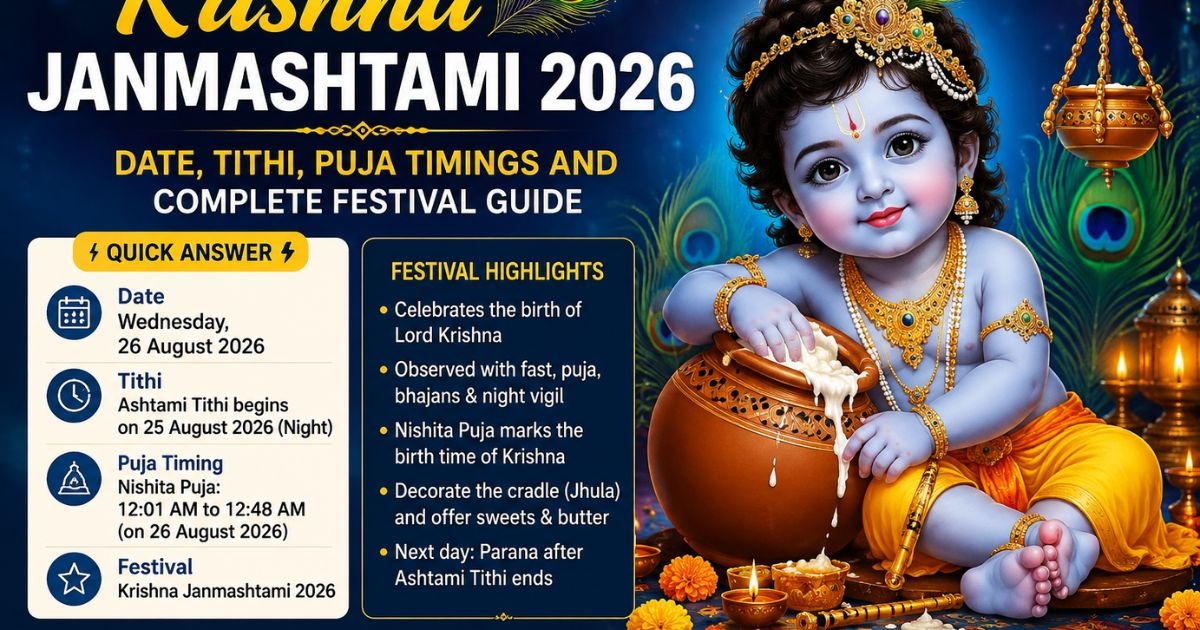
The Krishna Janmashtami 2026 festival is one of the most significant festivals for Krishna devotees. It is a celebration of the birth of Shri Krishna on Earth, which, according to the legend, took place at midnight in Mathura to Devaki and Vasudeva during the rule of the evil king Kansa.
In India, homes and temples are decorated with flowers, lights, Jhankis, swings, and pictures of Bal Gopal. Devotees fast for Janmashtami, chant Krishna mantras, sing bhajans, recite the Bhagavad Gita and Srimad Bhagavatam, offer special bhog, and await the special midnight Krishna Janmashtami puja.
However, no place can compare to Mathura and Vrindavan for celebrating this festival.
Traditionally, Mathura is called the birthplace of Shri Krishna, while Vrindavan and the Braj region are strongly linked to his childhood pastimes. As stated by the Mathura district tourism official website, Shri Krishna Janmabhoomi is the place where Krishna is said to have appeared in Kansa’s prison.
This guide is about how you should celebrate Janmashtami 2026 in Mathura Vrindavan – it gives all information on the date, Ashtami Tithi, Nishita Kaal, puja vidhi, vrat vidhi, temple visits, travel tips, Nandotsav, Dahi Handi.
Quick Answer
Krishna Janmashtami 2026 will be celebrated on Friday, September 4, 2026. The festival marks the divine birth of Lord Krishna and is observed on Krishna Paksha Ashtami in the Hindu month of Bhadrapada. In Mathura and Vrindavan, celebrations become especially vibrant, with temple decorations, bhajans, kirtans, Jhankis, fasting, abhishek, and the midnight Janmashtami puja.
For Vrindavan, the 2026 Nishita Kaal Puja is listed from approximately 11:56 PM on September 4 to 12:41 AM on September 5, while the exact timing varies by location. The Ashtami Tithi begins at approximately 2:25 AM on September 4 and ends around 12:13 AM on September 5 for Vrindavan. Parana is listed after sunrise on September 5, around 6:00 AM in Vrindavan.
The most important thing for pilgrims is simple: September 4 is the main Janmashtami date, while the midnight birth celebration naturally continues into September 5. Dahi Handi and Nandotsav are traditionally associated with the following day.
Krishna Janmashtami 2026 at a Glance
| Festival Detail | 2026 Information |
| Krishna Janmashtami 2026 Date | Friday, September 4, 2026 |
| Festival | Krishna Janmashtami / Gokulashtami |
| Tithi | Krishna Paksha Ashtami |
| Ashtami Tithi Begins | Approximately 2:25 AM, September 4 |
| Ashtami Tithi Ends | Approximately 12:13 AM, September 5 |
| Rohini Nakshatra | Active during the Janmashtami period |
| Nishita Kaal in Vrindavan | Approximately 11:56 PM – 12:41 AM |
| Midnight Birth Moment | Around 12:18 AM, September 5 in Vrindavan |
| Parana | After sunrise on September 5, according to the relevant observance |
| Dahi Handi / Nandotsav | Saturday, September 5 |
| Main Celebration Region | Mathura, Vrindavan, Gokul and Braj |
| Best Experience | Temple Janmotsav + next-day Nandotsav |
Panchang timings are location-sensitive, so devotees should confirm the final local muhurat with a trusted local panchang or temple before performing time-specific rituals.
What Is Krishna Janmashtami and Why Is It Celebrated?
Krishna Janmashtami is the Hindu festival celebrating the birth of Lord Krishna, traditionally regarded as the eighth avatar of Lord Vishnu.
According to Hindu tradition, Krishna was born to Devaki and Vasudeva in a prison cell in Mathura. Kansa, the ruler of Mathura and Devaki’s brother, feared a prophecy that Devaki’s eighth child would become the cause of his downfall.
Krishna’s birth is therefore celebrated not simply as a birthday but as a spiritual symbol of dharma overcoming adharma, hope overcoming darkness, and divine consciousness appearing in difficult times.
The festival is known by several names, including:
- Krishna Janmashtami
- Janmashtami
- Gokulashtami
- Krishnashtami
- Ashtami Rohini
- Krishna Jayanti
- Sree Jayanti
- Gokul Ashtami
The exact name and date can vary by region and religious tradition.
When Is Krishna Janmashtami in 2026?
Krishna Janmashtami 2026 falls on Friday, September 4, 2026.
The festival is determined according to the Hindu lunar calendar rather than the Gregorian calendar. It occurs during Krishna Paksha Ashtami, the eighth lunar day of the waning phase of the moon.
For Vrindavan, the 2026 Panchang places the beginning of Ashtami at approximately 2:25 AM on September 4 and its end at approximately 12:13 AM on September 5. The Nishita Puja period falls around 11:56 PM to 12:41 AM.
Why Does the Celebration Continue Into September 5?
This is where many visitors become confused.
The festival date is September 4, but the actual midnight birth ceremony occurs after 11:59 PM and therefore continues into the early hours of September 5.
In simple terms:
September 4 = Janmashtami fasting, daytime devotion and evening celebrations
Night of September 4–5 = Krishna Janma / Nishita Kaal
September 5 = post-midnight rituals, Parana and Nandotsav-related celebrations
That is why some calendars, websites, and travel plans may show both September 4 and September 5.
Krishna Janmashtami 2026 Tithi and Nishita Kaal
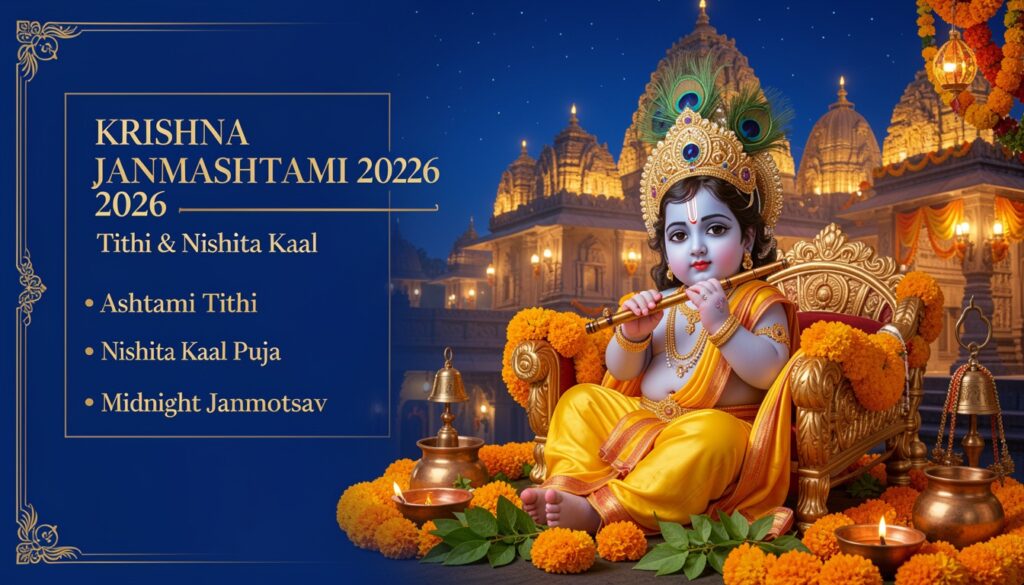
For Vrindavan, the available 2026 Panchang information gives the following schedule:
| Panchang Detail | Approximate 2026 Time |
| Ashtami Tithi Begins | 2:25 AM, September 4 |
| Ashtami Tithi Ends | 12:13 AM, September 5 |
| Rohini Nakshatra Begins | 12:29 AM, September 4 |
| Rohini Nakshatra Ends | 11:04 PM, September 4 |
| Nishita Puja | 11:56 PM – 12:41 AM |
| Midnight Moment | Around 12:18 AM |
| Parana | After sunrise, around 6:00 AM |
| Dahi Handi / Nandotsav | September 5 |
These are Vrindavan-specific approximate timings and should not be copied as universal timings for every city. Panchang calculations change according to geographical location.
Janmashtami Puja Timings 2026
The central ritual of Krishna Janmashtami is the midnight birth celebration.
Recommended Janmashtami Schedule
| Time | Ritual / Activity | What Devotees Do |
| Morning | Sankalpa | Take the vrat vow |
| Morning–Afternoon | Bhajan & Scripture Reading | Chant, pray, and read Krishna stories |
| Afternoon | Home Preparation | Decorate altar and Krishna Jhula |
| Evening | Shringar | Dress Bal Gopal and prepare bhog |
| 8:00 PM onward | Temple Programs | Kirtan, Jhankis and devotional performances |
| Around 11:56 PM | Nishita Kaal Begins | Begin the main midnight worship |
| Around Midnight | Krishna Janma | Abhishek, conch, bells, and Janmotsav |
| After Midnight | Aarti & Prasad | Offer bhog and distribute prasad |
| September 5 Morning | Parana | Break the fast according to one’s tradition |
The exact Janmashtami puja timings vary by city. For example, the published 2026 Vrindavan Panchang gives a Nishita window of approximately 11:56 PM–12:41 AM, while other cities have slightly different timings.
What Is Nishita Kaal?
Nishita Kaal refers to the sacred midnight period in Hindu timekeeping and is particularly important for Krishna Janmashtami because Krishna’s birth is traditionally associated with midnight.
During Nishita Kaal, devotees perform the most important part of the Janmashtami puja vidhi.
Typical rituals include:
- Bathing the Krishna idol
- Performing Panchamrit Abhishek
- Dressing Bal Gopal in fresh clothes
- Offering flowers and Tulsi
- Offering Makhan-Mishri and other bhog
- Performing Krishna Aarti
- Blowing the conch
- Ringing bells
- Rocking Krishna’s Jhula
- Chanting Krishna’s names
The midnight atmosphere is particularly powerful in Mathura and Vrindavan, where temples remain filled with devotees, kirtan and devotional music.
Janmashtami Puja Vidhi at Home
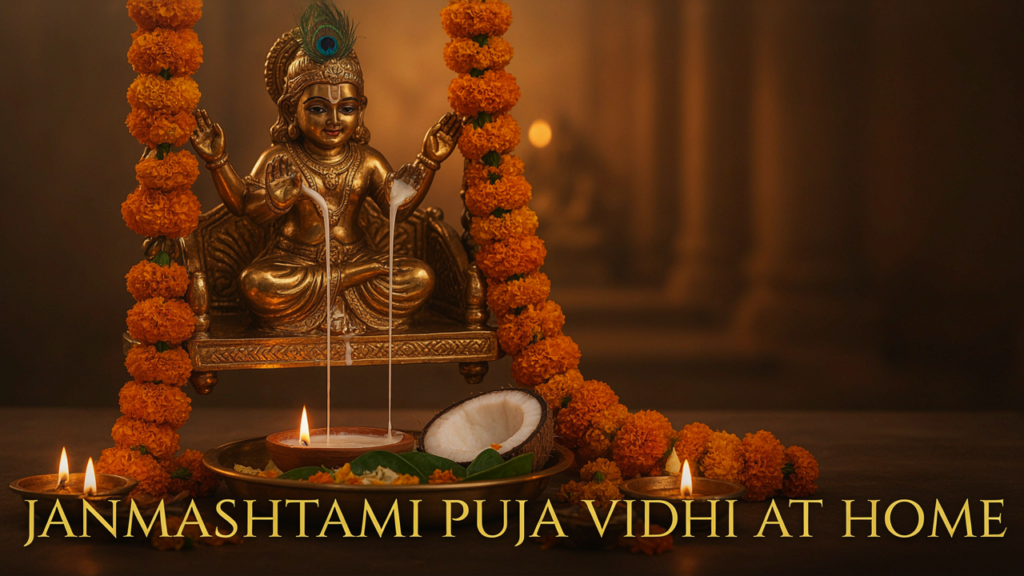
You do not need to travel to Mathura to celebrate Krishna Janmashtami. A simple and devotional home puja can be performed with a Bal Gopal or Laddu Gopal idol.
Step 1: Take the Janmashtami Sankalpa
On the morning of September 4, take a clean bath, wear fresh clothes and make your intention to observe the Janmashtami vrat.
You may pray according to your family tradition and ask Lord Krishna for devotion, peace and spiritual strength.
Step 2: Prepare the Krishna Jhula
Clean your puja area and decorate a small altar or cradle.
Common decorations include:
- Marigold flowers
- Jasmine
- Tulsi leaves
- Peacock feathers
- Yellow cloth
- Decorative lights
- Rangoli
- Krishna-themed ornaments
Many families also make small baby footprints using rice flour or another traditional material to symbolically welcome Bal Krishna.
Step 3: Observe Daytime Devotion
Spend the day in prayer, bhajan, kirtan, or scripture reading.
Popular devotional activities include:
- Hare Krishna mantra chanting
- Krishna bhajans
- Bhagavad Gita reading
- Srimad Bhagavatam reading
- Krishna Janma Katha
- Meditation
- Temple darshan
Step 4: Prepare Panchamrit
A simple Panchamrit preparation may include:
| Ingredient | Traditional Use |
| Milk | Main sacred ingredient |
| Curd | Purification and offering |
| Ghee | Auspiciousness |
| Honey | Sweetness |
| Sugar/Mishri | Sweet offering |
Use clean, fresh ingredients and follow your family’s or temple’s tradition.
Step 5: Perform Nishita Kaal Abhishek
At the appropriate local Nishita Kaal, bathe the Bal Gopal idol with Panchamrit and then clean water.
Dress the deity in fresh clothes and decorate with flowers, Tulsi, and ornaments.
Step 6: Offer Krishna Bhog
Popular Janmashtami bhog includes:
- Makhan-Mishri
- Panjiri
- Fruits
- Milk
- Makhana
- Sabudana preparations
- Homemade sweets
- Dhaniya panjiri
- Dry fruits
Tulsi is traditionally offered with Krishna bhog according to many Vaishnava practices.
Step 7: Perform Krishna Aarti
Light a diya and perform aarti while singing Krishna devotional songs.
The sound of bells and conch shells marks the joyous moment of Krishna’s birth.
Step 8: Rock the Krishna Jhula
After the Janma celebration, devotees gently rock the cradle of Bal Gopal while chanting devotional names.
The ceremony symbolizes welcoming the divine child into the home.
Janmashtami Fasting Rules 2026
The Janmashtami vrat is traditionally observed by many devotees. However, fasting practices differ between individuals, families, and sampradayas.
| Fast Type | General Practice | Suitable For |
| Nirjala Vrat | No food or water | Experienced devotees following this tradition |
| Phalahar Vrat | Fruits, milk and permitted fasting foods | Common fasting option |
| Sattvic Vrat | Non-grain vegetarian fasting foods | Families |
| Light Vrat | Simple permitted food | Those unable to observe a strict fast |
Foods Commonly Eaten During Janmashtami Fast
Depending on one’s tradition, devotees may consume:
- Fruits
- Milk
- Curd
- Coconut
- Makhana
- Sabudana
- Samak rice
- Kuttu flour
- Singhara flour
- Potatoes
- Sweet potatoes
- Nuts
- Rock salt
- Panjiri
Foods Commonly Avoided
During a traditional fasting observance, devotees commonly avoid:
- Wheat
- Regular rice
- Pulses
- Grains
- Meat
- Fish
- Eggs
- Onion
- Garlic
- Alcohol
People with medical conditions, pregnancy, diabetes, or other dietary needs should not undertake restrictive fasting without appropriate professional advice.
When Should You Break the Janmashtami Fast?
This is another area where traditions differ.
Some devotees break the fast immediately after the midnight Janma ceremony, while others follow a stricter Parana rule and wait until the appropriate tithi or nakshatra conditions have ended.
For Vrindavan, the 2026 Panchang lists Parana after sunrise on September 5, around 6:00 AM.
Therefore, do not rely on a generic internet time if you are following a specific sampradaya. Check the local Panchang and the rules followed by your temple or family.
Is Janmashtami on September 4 or September 5?
The simplest answer is:
The 2026 Krishna Janmashtami date is September 4.
The confusion comes because the midnight Janma ceremony occurs during the night of September 4 and continues into September 5.
Current 2026 Panchang information for Vrindavan gives September 4 as Janmashtami and places the Nishita Puja from approximately 11:56 PM September 4 to 12:41 AM September 5.
This means a website displaying “September 5” may be referring to the post-midnight birth moment, not necessarily a separate Janmashtami festival date.
Smarta and Vaishnava Observance
| Tradition | 2026 Date | Explanation |
| General Hindu calendar observance | September 4 | Main Janmashtami |
| Smarta tradition | September 4 | Based on the relevant midnight tithi |
| Vaishnava/ISKCON calendars | Confirm locally | Institutional calendars should be followed for the specific temple |
| Midnight Janma | Night of Sep 4–5 | Birth celebration occurs after midnight |
| Nandotsav | September 5 | Traditional celebration following Krishna’s birth |
Importantly, ISKCON should not automatically be described as observing September 5 in 2026. Current 2026 ISKCON-related calendar information also points to September 4 as the Janmashtami date, while the actual midnight celebration crosses into September 5.
Krishna Janmashtami 2026 in Mathura and Vrindavan
For pilgrims, the biggest attraction is the Mathura Vrindavan Janmashtami celebration.
The official Mathura district website identifies Mathura as the traditional birthplace of Krishna and lists major religious sites including Shri Krishna Janmabhoomi, Banke Bihari Temple, Prem Mandir and ISKCON Temple.
Shri Krishna Janmabhoomi, Mathura
This is the most important location for visitors interested in the traditional Krishna birth story.
The Mathura district administration describes the site as the place where Krishna is traditionally believed to have manifested in Kansa’s prison house.
On Janmashtami, devotees gather for special worship, decoration, devotional singing and the midnight Janmotsav.
Travel tip: Do not assume you can arrive minutes before midnight and enter immediately. Festival security, crowd controls and entry arrangements can change.
Banke Bihari Temple, Vrindavan
Banke Bihari Temple is one of Vrindavan’s most famous Krishna temples.
The temple is especially popular during major festivals, and crowd density can become extremely high. Visitors should follow the temple’s official instructions and avoid pushing toward the sanctum.
ISKCON Krishna Balaram Mandir
The ISKCON temple is well known for kirtan, devotional singing, Krishna worship, and large festival gatherings.
Because institutional festival calendars can differ from general household observances, visitors should verify the 2026 program directly with the temple before travelling.
Prem Mandir
Prem Mandir is especially popular for its illuminated architecture and Krishna-themed tableaux.
It can be a good addition to a Janmashtami itinerary, particularly before the most intense midnight crowds.
Dwarkadhish Temple, Mathura
Dwarkadhish Temple is another major Mathura pilgrimage site and can be included alongside Krishna Janmabhoomi and Vishram Ghat.
Vishram Ghat
Vishram Ghat on the Yamuna provides a different atmosphere from the packed temple interiors.
The evening Yamuna Aarti, lamps, and devotional singing make it an important stop for many pilgrims.
Best Places to Experience Janmashtami in Braj
| Place | Why Visit | Best Experience |
| Krishna Janmabhoomi | Traditional birthplace | Midnight Janmotsav |
| Banke Bihari Temple | Famous Vrindavan Krishna temple | Festival darshan |
| ISKCON Vrindavan | Kirtan and Vaishnava devotion | Special Janmashtami program |
| Prem Mandir | Illuminated Krishna displays | Evening visit |
| Dwarkadhish Temple | Historic Mathura temple | Special festival darshan |
| Vishram Ghat | Yamuna and devotional atmosphere | Evening Aarti |
| Gokul | Krishna’s childhood associations | Nandotsav |
| Nandgaon | Nanda Baba traditions | Post-Janmashtami celebration |
Nandotsav and Dahi Handi 2026
The day following Krishna Janmashtami is traditionally associated with Nandotsav, celebrating the joy in Nanda’s household after Krishna’s birth.
Gokul is particularly important in the Krishna tradition because it is associated with Krishna’s childhood.
Dahi Handi recreates the playful butter-stealing stories associated with Krishna’s childhood. Participants form human pyramids to reach and break a suspended pot.
Because local programs, security arrangements, and timings can change, visitors should confirm the 2026 Gokul and Mathura district schedule close to the festival.
How Janmashtami Is Celebrated in Mathura
Mathura celebrates Janmashtami with a combination of:
- Temple worship
- Krishna Janma Katha
- Jhankis
- Bhajans
- Kirtans
- Abhishek
- Midnight Aarti
- Conch blowing
- Bell ringing
- Krishna cradle ceremonies
- Religious processions
- Decorative lighting
- Yamuna Aarti
The official Mathura district information also highlights temple decoration, fasting, Jhankis, cradle worship, and Ras Leela as parts of Janmashtami celebrations.
How Janmashtami Is Celebrated in Vrindavan
Vrindavan’s celebration has a distinct devotional atmosphere.
The town becomes filled with:
- Hare Krishna chanting
- Radha-Krishna bhajans
- Kirtan
- Temple decorations
- Krishna Jhankis
- Floral decoration
- Devotional music
- Pilgrims
- Sadhus and spiritual groups
The Mathura district tourism website lists Vrindavan’s major Krishna-related temples among the region’s principal attractions.
Janmashtami 2026 Travel Guide: How to Reach Mathura and Vrindavan
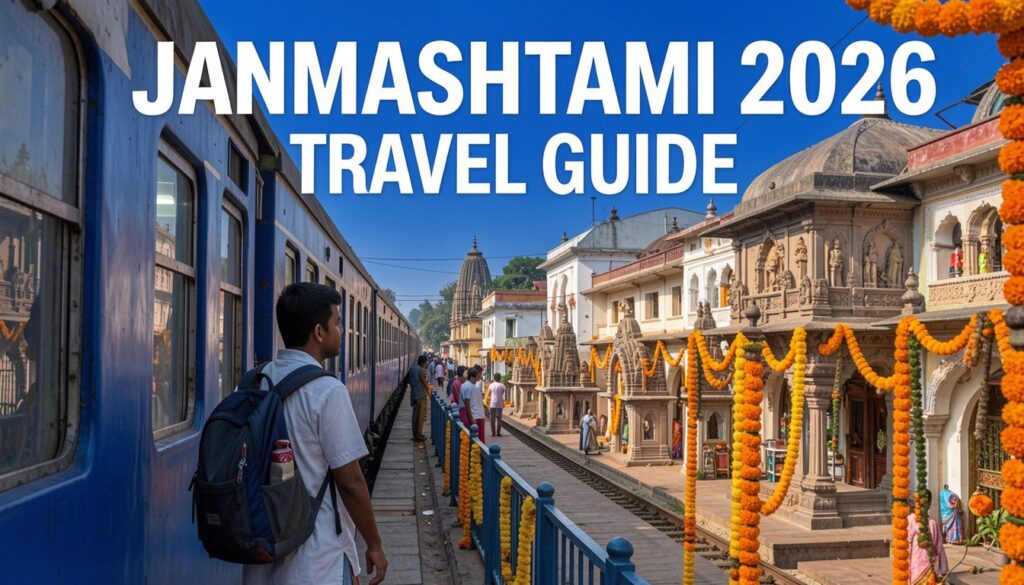
Mathura is well connected by rail and road, with airports in Agra and Delhi serving as the nearest major air connections.
The official Mathura district website lists Mathura Junction and Mathura Cantt as railway stations and identifies Kheria Airport in Agra and Indira Gandhi International Airport in Delhi as the principal nearby airport options.
| Travel Option | Approximate Route | Best For |
| Train | Delhi → Mathura Junction | Most convenient for many pilgrims |
| Train | Agra → Mathura | Short regional connection |
| Flight + Road | Delhi Airport → Mathura | International/domestic visitors |
| Flight + Road | Agra Airport → Mathura | Visitors combining Agra |
| Road | Delhi → Mathura | Private vehicle/taxi |
| Road | Agra → Mathura | Visitors combining Agra and Braj |
Important Festival Advice
Do not plan your Janmashtami journey based only on normal travel times.
During major festivals:
- Traffic can become extremely slow.
- Parking can become difficult.
- Temple queues can expand rapidly.
- Road restrictions may be imposed.
- Walking may become necessary.
- Public transport may be crowded.
- Mobile connectivity can become unreliable in dense areas.
Always check official local traffic and temple announcements before setting out.
Where Should You Stay for Janmashtami 2026?
For a midnight temple visit, location matters more than luxury.
Good areas to consider include:
- Central Mathura
- Areas around Krishna Janmabhoomi
- Central Vrindavan
- Raman Reti area
- Areas near major Vrindavan temples
If your priority is the Krishna Janmabhoomi midnight celebration, staying closer to Mathura can reduce unnecessary late-night travel.
If your priority is Vrindavan temples, staying within Vrindavan may make more sense.
Accommodation Planning Table
| Visitor Type | Better Base |
| Krishna Janmabhoomi priority | Mathura |
| Banke Bihari priority | Vrindavan |
| ISKCON priority | Vrindavan |
| Family pilgrimage | Central Vrindavan or Mathura |
| Short Delhi trip | Mathura |
| Two-day pilgrimage | One night Mathura + one night Vrindavan or a convenient central base |
Book early because festival-period demand can be significantly higher than ordinary September dates.
What to Wear for Janmashtami in Mathura and Vrindavan
Wear comfortable, modest clothing suitable for temples and long periods of walking.
Recommended:
- Cotton kurta-pajama
- Salwar kameez
- Comfortable trousers
- Long breathable clothing
- Flat sandals
- Comfortable walking shoes
Avoid:
- High heels
- Heavy bags
- Expensive jewellery
- Loose valuables
- Clothing unsuitable for temple environments
September can remain warm, and dense crowds can make conditions feel hotter.
Janmashtami Safety Tips
If you are travelling with children, elderly people or first-time visitors, safety should be part of the itinerary.
Follow These Practical Tips
- Keep your group together.
- Select a fixed meeting point.
- Carry identification.
- Keep emergency contact numbers saved.
- Carry water.
- Wear comfortable footwear.
- Avoid unnecessary luggage.
- Follow police and temple instructions.
- Do not push through crowds.
- Keep children within arm’s reach.
- Avoid standing in dangerous bottlenecks.
- Confirm temple entry rules before travelling.
The official Mathura district website notes that photography is prohibited inside the Krishna Janmabhoomi complex, so visitors should follow on-site restrictions rather than assuming normal photography rules apply during the festival.
Ideal 2-Day Janmashtami 2026 Itinerary
Day 1 — September 4: Krishna Janmashtami
Morning
- Arrive in Mathura
- Hotel check-in
- Rest
- Begin your vrat if observing one
Afternoon
- Visit selected temples
- Krishna Janmabhoomi area
- Dwarkadhish Temple
- Rest before evening crowds
Evening
- Vishram Ghat
- Yamuna Aarti
- Return toward your chosen Janmashtami celebration location
- Join devotional programs
Late Night
- Nishita Kaal preparation
- Krishna Janma celebration
- Abhishek
- Aarti
- Krishna Jhula
- Prasad
Day 2 — September 5: Nandotsav
Morning
- Parana according to your tradition
- Breakfast/rest
- Morning temple darshan
Afternoon
- Gokul
- Nandotsav
- Dahi Handi and local celebrations
Evening
- Return to Vrindavan
- Prem Mandir
- ISKCON or another selected temple
- Final Yamuna-side visit
Is Janmashtami in Mathura-Vrindavan Worth Visiting?
Yes — especially if you want to experience Krishna Janmashtami as a pilgrimage rather than simply as a one-day sightseeing trip.
The atmosphere is intense, crowded, and sometimes physically demanding. But the combination of midnight worship, devotional music, temple decoration, Krishna Jhankis and the cultural atmosphere of Braj makes it a unique festival experience.
For families with small children or elderly travellers, however, it may be better to avoid the most crowded midnight zones and enjoy early-morning darshan or less congested celebrations.
Common Janmashtami Travel Mistakes to Avoid
Mistake 1: Arriving Just Before Midnight
The most important lesson is to arrive early.
Mistake 2: Trying to Visit Too Many Temples
On Janmashtami night, normal travel times do not apply.
Choose two or three priority experiences instead of trying to cover the entire Braj circuit.
Mistake 3: Ignoring Local Traffic Restrictions
Festival traffic arrangements can change quickly.
Mistake 4: Carrying Too Much Luggage
Travel light.
Mistake 5: Assuming All Temples Follow Identical Timings
Temple schedules vary and can change during festivals.
Mistake 6: Following a Generic Parana Time
Fast-breaking rules vary by tradition and location.
Mistake 7: Confusing September 4 With September 5
Remember:
September 4 = Janmashtami
Night of September 4–5 = Midnight Janma
September 5 = following-day celebrations such as Nandotsav
Janmashtami 2026: Essential Checklist
| Before the Trip | During the Festival |
| Book hotel early | Carry minimal luggage |
| Confirm temple program | Keep water with you |
| Check Panchang timing | Wear comfortable shoes |
| Plan your transport | Stay with your group |
| Save emergency contacts | Follow security instructions |
| Choose priority temples | Avoid pushing in crowds |
| Confirm fasting rules | Respect temple photography rules |
Frequently Asked Questions
When is Krishna Janmashtami in 2026?
Krishna Janmashtami 2026 will be celebrated on Friday, September 4, 2026. In Vrindavan, the midnight Nishita Puja extends into the early hours of September 5.
What is the Krishna Janmashtami 2026 date and day?
The date is September 4, 2026, Friday. The festival is observed on Krishna Paksha Ashtami.
What is the Nishita Kaal timing for Janmashtami 2026?
For Vrindavan, the published 2026 Panchang gives approximately 11:56 PM on September 4 to 12:41 AM on September 5. Exact timings vary by city.
What is the Ashtami Tithi timing in 2026?
For Vrindavan, Ashtami Tithi begins at approximately 2:25 AM on September 4 and ends around 12:13 AM on September 5.
Why is Krishna Janmashtami celebrated at midnight?
According to Hindu tradition, Lord Krishna was born at midnight. Therefore, devotees perform the main Janmashtami puja during Nishita Kaal, followed by abhishek, aarti, bhog, and Krishna Jhula rituals.
Is Janmashtami on September 4 or September 5?
The main Krishna Janmashtami 2026 date is September 4. The confusion comes because the midnight birth ceremony crosses into September 5.
What can I eat during the Janmashtami fast?
Depending on your tradition, fasting foods can include fruits, milk, curd, makhana, sabudana, samak rice, kuttu, singhara flour, potatoes, nuts, and rock salt. Fasting rules differ between families and sampradayas.
When should I break the Janmashtami fast?
Parana depends on the tradition you follow. For Vrindavan, the 2026 Panchang lists Parana after sunrise on September 5, around 6:00 AM. Devotees following a particular sampradaya should follow its prescribed rules.
What is the best place to celebrate Janmashtami in Mathura and Vrindavan?
For the traditional Krishna birth experience, Shri Krishna Janmabhoomi in Mathura is one of the most significant places. Vrindavan’s temples, including Banke Bihari and ISKCON, offer different devotional experiences. The official Mathura tourism website lists these among the area’s major religious attractions.
Is Mathura-Vrindavan safe and suitable for families on Janmashtami?
Yes, but the festival can be extremely crowded. Families with young children, elderly people, or mobility concerns should plan carefully, avoid dangerous crowd bottlenecks, travel light, and consider early-morning or less crowded darshan instead of the busiest midnight areas.
Final Thoughts
Krishna Janmashtami 2026 is on Friday, September 4, with the sacred midnight Janma celebration taking place during the night of September 4–5. For Vrindavan, the Nishita Kaal window is approximately 11:56 PM to 12:41 AM, although exact timings vary by location.
If you are celebrating at home, focus on devotion rather than complexity. A clean altar, Bal Gopal idol, Krishna Jhula, bhajan, fasting according to your ability, Panchamrit Abhishek, bhog and midnight aarti are enough to create a meaningful celebration.
If you are travelling to Mathura and Vrindavan for Janmashtami 2026, plan differently from a normal sightseeing trip. Book accommodation early, select your priority temples, check local festival arrangements and leave plenty of time for walking and security checks.
The official Mathura district information confirms the region’s deep association with Krishna and highlights Shri Krishna Janmabhoomi, Banke Bihari Temple, ISKCON Temple, Prem Mandir, Vishram Ghat and other sacred places as major attractions.
Most importantly, remember that Janmashtami is not simply about reaching a temple at midnight. It is about experiencing the devotion of Braj — the chanting, the lamps, the Krishna Jhankis, the bhajans, the Yamuna, the decorated temples and the collective joy of devotees celebrating the birth of Shri Krishna.
Jai Shri Krishna! 🙏
How to Meet Premanand Ji Maharaj: Complete Darshan, Registration, Ashram & Vrindavan Guide 2026