Matera Italy is one of the most distinctive destinations in southern Europe, known for its ancient cave dwellings, stone churches, winding lanes, and dramatic landscape. Located in Basilicata in southern Italy, the city is famous for the Sassi districts, where homes and churches were carved directly into the rock. Walking through Matera feels less like visiting an ordinary historic town and more like stepping into a landscape shaped by thousands of years of human settlement.
The city has changed enormously over time. Once associated with poverty and difficult living conditions, Matera has become an important cultural destination and a UNESCO World Heritage site. Today, visitors can explore the Sassi, enter rock-hewn churches, discover viewpoints over the Gravina canyon, enjoy traditional Basilicata food, and stay in beautifully restored cave accommodation. Matera Italy is particularly rewarding for travelers who enjoy history, architecture, photography, and places with a strong sense of character.
Why Visit Matera Italy?
Matera stands apart from many Italian destinations because its appeal comes from an entire historic landscape rather than one famous monument. The Sassi districts form a network of stone houses, stairways, courtyards, churches, and narrow passages built into the slopes of a deep ravine.
The city also offers a remarkable example of how an old settlement can be preserved and adapted for modern visitors. Some former cave homes have become museums, restaurants, hotels, and cultural spaces, while other areas continue to function as ordinary neighborhoods.
The Sassi of Matera
The Sassi are the heart of the city’s identity. The two historic districts, Sasso Caveoso and Sasso Barisano, contain layers of buildings and rock-cut spaces developed over centuries.
Sasso Caveoso is often associated with a more rugged appearance, while Sasso Barisano contains many restored buildings and cave structures. Both are worth exploring on foot.
A Destination for Slow Travel
Matera is not a place where you need to rush between dozens of attractions. Its streets, stairways, viewpoints, and stone architecture are part of the experience.
Allowing time to wander without a strict route can reveal small churches, courtyards, local shops, and viewpoints that may not appear on a standard itinerary.
Exploring the Sassi and Matera’s Historic Center
The best way to understand Matera is to explore its historic districts on foot. The Sassi are compact enough to walk through, although the constant stairs and uneven surfaces require comfortable footwear.
Start with the main viewpoints and gradually move deeper into the old neighborhoods. During the day, the stone buildings create changing patterns of light and shadow, while evening brings a completely different atmosphere as the caves and streets become softly illuminated.
Sasso Caveoso
Sasso Caveoso has a rugged, almost theatrical landscape. Many structures appear to emerge directly from the rock, and the district provides access to several cave churches and viewpoints.
Sasso Barisano
Sasso Barisano has been extensively restored and contains numerous accommodation options, restaurants, and visitor facilities.
It is an excellent area for travelers who want to stay close to the historic atmosphere while still having convenient access to services.
Piazza Vittorio Veneto
This central square is an important meeting point between the modern city and the historic districts. From nearby areas, visitors can access viewpoints overlooking the Sassi and begin walking routes through the old city.
Matera Cathedral
The Cathedral of Maria Santissima della Bruna and Sant’Eustachio stands on the highest part of the Civita area. Dating from the thirteenth century, it provides a useful contrast to the cave architecture below.
The cathedral and surrounding streets are particularly worthwhile for travelers interested in understanding how Matera’s religious and civic history developed alongside its cave settlements.
Matera’s Rock Churches and Ancient History

Matera’s history extends far beyond the medieval buildings visible today. Archaeological evidence shows that people have lived in and around the area for thousands of years.
The region’s soft rock made it possible for communities to carve homes, storage spaces, places of worship, and other structures directly into the landscape.
Rock-Hewn Churches
The rupestrian churches are among Matera’s most fascinating cultural attractions. Many were carved into rock and decorated with religious paintings.
Some churches are located within the Sassi, while others are scattered across the surrounding Murgia landscape.
Santa Maria de Idris
Santa Maria de Idris is one of the best-known rock churches in Matera. Carved into a rocky outcrop, it is particularly striking because of its position above the surrounding landscape.
Visitors should check current opening conditions because access to individual churches can vary.
Santa Lucia alle Malve
Santa Lucia alle Malve is another significant rock church associated with Matera’s religious history. Its interior provides a glimpse into the traditions of the communities that once lived in the caves.
Casa Grotta di Vico Solitario
A cave house museum can help visitors understand what everyday domestic life was like before the Sassi were modernized.
Instead of viewing the caves only as beautiful architecture, these museums provide important context about how families actually lived in them.
Why the History Matters
Matera’s transformation is an important part of its story. The Sassi were once home to large communities living in difficult conditions, and residents were gradually relocated during the twentieth century.
Today, restoration has turned many abandoned structures into functioning parts of the city, but the historic character remains central to Matera’s identity.
Best Things to Do in Matera
Matera is best experienced through a combination of sightseeing, walking, cultural visits, and time spent enjoying the city itself.
Watch the City From a Viewpoint
Matera has several viewpoints where you can see the Sassi spread across the rocky slopes. The view changes considerably with the time of day.
Early morning offers softer light and fewer visitors, while evening can create a dramatic contrast between the illuminated caves and darkening landscape.
Visit Casa Noha
Casa Noha is a multimedia cultural experience that helps explain Matera’s history and transformation. It can be a useful first stop because understanding the city’s past makes the Sassi much more meaningful.
Explore Local Churches
Do not limit your sightseeing to the largest religious buildings. Smaller churches and rock-cut places of worship reveal how deeply religion was connected to everyday life.
Take a Guided Walking Tour
A knowledgeable local guide can add valuable context to the Sassi. Many details are easy to miss when exploring independently, especially the differences between homes, cisterns, churches, and other rock-cut spaces.
Enjoy Matera After Dark
The Sassi look completely different in the evening. Many stone buildings and cave spaces are illuminated, creating a warm atmosphere throughout the historic districts.
An evening walk followed by dinner in the old city can be one of the simplest ways to experience Matera.
| Experience | Why It Matters | Recommended Time |
| Walk through Sasso Caveoso | Rugged cave architecture and historic streets | 2–3 hours |
| Explore Sasso Barisano | Restored caves, restaurants, and accommodation | 2–3 hours |
| Visit rock churches | Religious art and cave architecture | 1–2 hours |
| Matera viewpoints | Panoramic views over the Sassi | 30–60 minutes |
| Historic center | Cathedral, squares, shops, cafés | 2–3 hours |
| Evening walk | Illuminated stone cityscape | 1–2 hours |
Best Time to Visit Matera
Matera can be visited throughout the year, but spring and autumn are often particularly comfortable for walking and sightseeing.
The city’s historic areas involve many stairs and uneven surfaces, so comfortable temperatures can make a significant difference.
Spring
Spring brings generally pleasant conditions for exploring the Sassi and surrounding countryside. It is a good season for travelers who want to combine city sightseeing with outdoor walks.
Summer
Summer can be hot, particularly during the middle of the day. If you visit during the warmer months, plan outdoor walking for morning or late afternoon and keep the hottest hours for museums, meals, or rest.
Autumn
Autumn is another attractive season for exploring Matera. Temperatures are often more comfortable for long walks, and the city can feel less intense than during the height of summer.
Winter
Winter is quieter and can offer a different experience of the Sassi. Some businesses and attractions may operate on reduced seasonal schedules, so check opening information before planning your day.
| Season | Best For | Travel Considerations |
| Spring | Walking, sightseeing, countryside | Comfortable conditions, variable weather |
| Summer | Long daylight, evening exploration | Hot midday temperatures |
| Autumn | Walking and cultural visits | Mild conditions, changing weather |
| Winter | Quiet sightseeing | Cooler weather and seasonal schedules |
Whenever you travel, check the local forecast and attraction opening hours shortly before your visit.
How to Get to Matera
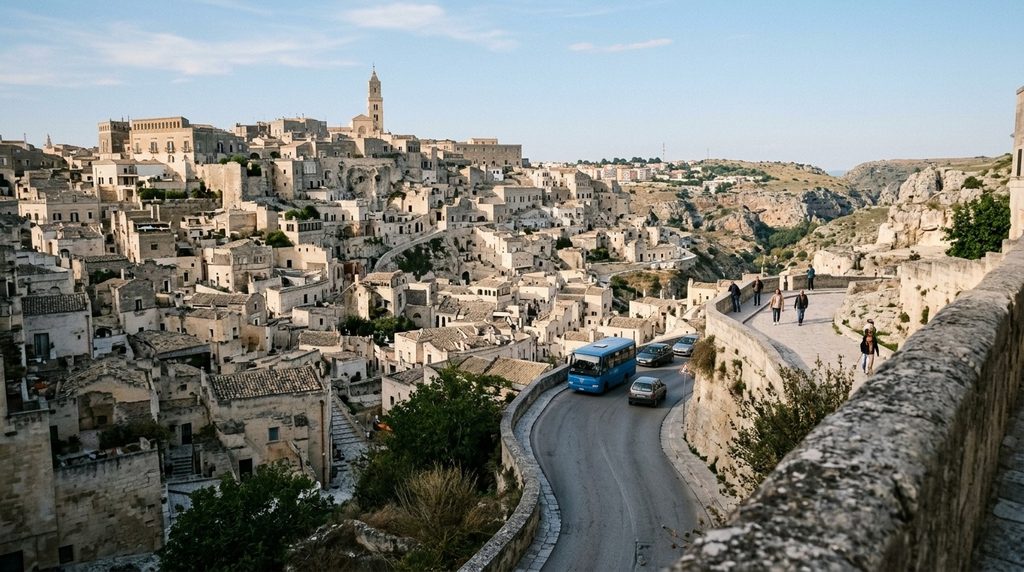
Matera is located in Basilicata, in southern Italy, and can be reached by road and public transportation from several major cities.
There is no airport directly in Matera, so most travelers use nearby airports and continue by train, bus, or rental car.
From Bari
Bari is one of the most convenient gateways for international visitors. Bari Karol Wojtyła Airport has connections with various Italian and European destinations.
From Bari, travelers can continue toward Matera by train, bus, rental car, or other regional transportation options depending on the current timetable.
By Train
Matera is served by regional rail connections rather than Italy’s main high-speed rail network. Services and routes can differ from the national Trenitalia network, so travelers should check the current operator and timetable before departure.
By Car
Driving can be useful if you plan to explore Basilicata and nearby destinations beyond Matera.
However, parking and access restrictions can make driving inside the historic center inconvenient. Many streets in or near the Sassi are pedestrianized or subject to traffic restrictions.
By Bus
Bus connections can be useful from Bari and other southern Italian destinations. This can be a practical option for travelers who do not want to rent a car.
Where to Stay in Matera
Staying overnight in Matera is highly recommended if your schedule allows. The city feels noticeably different once the day visitors leave, and evening walks through the illuminated Sassi are worth experiencing.
Staying in the Sassi
Cave hotels and guesthouses are among Matera’s most distinctive accommodation options. Some are built inside carefully restored historic structures.
Staying here gives you immediate access to the old neighborhoods, although stairs and uneven surfaces may make certain properties unsuitable for travelers with mobility limitations.
Staying in the Modern City
Accommodation outside the Sassi can offer easier vehicle access, larger rooms, and potentially more straightforward logistics.
You can still reach the historic center on foot or by local transportation, depending on where you stay.
What to Check Before Booking
Because Matera’s historic buildings have unusual layouts, look carefully at accommodation descriptions.
Check whether the property has elevators, how many stairs are involved, where luggage drop-off is possible, and how far the nearest parking area is.
| Accommodation Area | Best For | Things to Consider |
| Sasso Caveoso | Historic atmosphere | Steep streets and stairs |
| Sasso Barisano | Cave stays and restaurants | Uneven walking surfaces |
| Civita area | Historic center access | Limited vehicle access |
| Modern Matera | Convenience and easier access | Less immersive historic setting |
For travelers with mobility concerns, accommodation location is especially important. A property that looks close on a map may still require significant stair climbing.
Food and Local Flavors to Try
Matera’s food reflects the traditions of Basilicata, with dishes built around simple ingredients, grains, vegetables, legumes, meat, and local bread.
The cuisine is generally less elaborate than the setting in which you eat it, which is part of its appeal.
Pane di Matera
Pane di Matera is one of the area’s best-known traditional foods. The bread has a distinctive shape and texture and has long been an important part of local food culture.
Try it alongside regional dishes rather than treating it simply as a side item.
Orecchiette and Pasta
Southern Italian pasta traditions are strongly represented in Basilicata. Menus may include handmade pasta served with vegetables, tomato-based sauces, cheese, or meat.
Peppers and Vegetables
Basilicata cuisine makes good use of vegetables and locally available ingredients. Seasonal dishes can vary, so asking what is prepared locally can lead to a better meal than choosing only familiar dishes.
Local Wines
Basilicata produces regional wines, including Aglianico del Vulture. If you enjoy wine, look for bottles from Basilicata rather than limiting your choices to famous national labels.
Where to Eat
Restaurants inside the Sassi offer atmospheric settings, while eateries in the modern city can provide a more everyday local dining experience.
For dinner, reservations can be useful during busy travel periods, particularly for well-known restaurants with limited seating.
Day Trips and Places Near Matera

Matera works well as part of a wider southern Italy itinerary. Its location makes it possible to explore other parts of Basilicata and neighboring Puglia.
Murgia Materana
The Murgia Materana landscape lies across the Gravina from the Sassi. It is especially interesting for travelers who want to understand the natural setting that shaped Matera’s development.
Walking routes provide views back toward the Sassi and access to additional rock churches.
Alberobello
Alberobello in nearby Puglia is famous for its trulli, traditional stone buildings with conical roofs.
The town can be combined with Matera on a longer southern Italy itinerary, although travel time should be considered carefully if attempting it as a day trip.
Altamura
Altamura is known for its historic center and traditional bread. Its proximity to Matera makes it a possible addition for travelers with more time.
Gravina in Puglia
Gravina in Puglia is another historic town characterized by ravines, churches, and cave architecture. It provides an interesting comparison with Matera.
How Much Time to Allow?
A half-day excursion may work for nearby destinations, but a full day gives you more flexibility.
Avoid trying to combine too many towns in one day. Southern Italy’s smaller roads and transportation schedules can make an ambitious itinerary tiring.
Practical Tips for Visiting Matera
Matera is relatively straightforward to visit, but its historic terrain requires some preparation.
Wear Comfortable Shoes
This is perhaps the most important practical tip. The Sassi involve stone surfaces, steps, slopes, and uneven paths.
Comfortable shoes with good grip will make your visit considerably easier.
Travel Light
If you are staying in a cave hotel, moving a large suitcase through narrow streets and stairways can be difficult.
If possible, pack efficiently and confirm luggage access with your accommodation before arrival.
Start Early
The Sassi can become busy during peak sightseeing periods. Starting early allows you to explore some areas more peacefully and avoid the strongest midday heat during warmer months.
Stay After Sunset
A day trip can show you Matera’s major attractions, but staying overnight gives you another perspective.
The illuminated Sassi create a completely different atmosphere after dark.
Bring Water
Walking around Matera can be physically demanding, especially during warmer weather. Carry water and take breaks when needed.
Check Attraction Hours
Individual churches, museums, and cultural sites can have different opening times and seasonal schedules.
Confirm current hours before building your itinerary around a specific attraction.
Respect Historic Spaces
The caves and stone structures are not simply decorative scenery. They represent centuries of human history and, in many cases, former homes and places of worship.
Follow signs, respect barriers, and avoid touching fragile surfaces or religious artwork.
FAQs
Is Matera Italy worth visiting?
Yes. Matera Italy is especially worthwhile for travelers interested in ancient settlements, cave architecture, history, photography, food, and unusual cultural landscapes.
How many days do you need in Matera?
Two full days are ideal for seeing the Sassi, visiting rock churches and museums, enjoying local food, and exploring viewpoints without rushing. A third day allows time for nearby attractions.
What is Matera famous for?
Matera is best known for the Sassi, ancient cave dwellings and rock-cut churches built into the city’s landscape. Its historic districts are recognized as a UNESCO World Heritage site.
Can you visit Matera without a car?
Yes. Matera’s historic center and Sassi are best explored on foot, and the city can be reached by public transportation from nearby destinations such as Bari. A car becomes more useful if you plan to explore the surrounding region.
What is the best time to visit Matera?
Spring and autumn are often comfortable seasons for walking and sightseeing. Summer can be hot, while winter is quieter but may have shorter or seasonal attraction schedules.
Conclusion:
Matera Italy is one of those destinations where the landscape and history are inseparable. The ancient Sassi, rock churches, stone stairways, viewpoints, and surrounding Gravina create a setting unlike most other Italian cities. Beyond its visual appeal, Matera also tells a deeper story about settlement, hardship, restoration, and the preservation of a remarkable cultural landscape.
Whether you visit for a weekend or include it in a longer southern Italy itinerary, Matera Italy deserves enough time to be experienced slowly. Walk through the Sassi, learn the history behind the caves, try local Basilicata food, watch the city change as the light fades, and leave room for the quiet moments between the major sights.
Read more:Porto Santo: Complete Travel Guide to Madeira’s Golden Island